Tokyo Ondo by Shinpei Nakayama and part of Rachmaninoff’s Prelude in G Minor, Op. 23, No. 5.
All works
Tradition reimagined
Tokyo Ondo Rhapsody after Rachmaninoff
Japanese festival music meets the rhythmic force of Rachmaninoff in a new piano work.
Concert hall: BAO-Y HALL TOKYO ↗
The musical doorway
Two musical worlds meet through rhythm
Tokyo Ondo, composed by Shinpei Nakayama, is one of Japan’s best-known traditional festival songs. BAO-Y had long felt that the distinctive rhythm and melody of Japanese traditional music belonged to a different world from classical music, and earlier attempts to bring the two together had not yet produced the result he wanted.
This work combines the Tokyo Ondo melody with part of Sergei Rachmaninoff’s Prelude in G Minor, Op. 23, No. 5, from Ten Preludes, Op. 23. The prelude’s strong, clearly defined rhythm meets Tokyo Ondo and creates an energy that can suggest Japanese drums being played with great force.
The intention is not simply to dress Tokyo Ondo in a classical style, but to bring the vitality of a Japanese summer festival together with the weight and power of the classical piano. The result is technically demanding, particularly as the music accelerates toward the ending.
What to notice
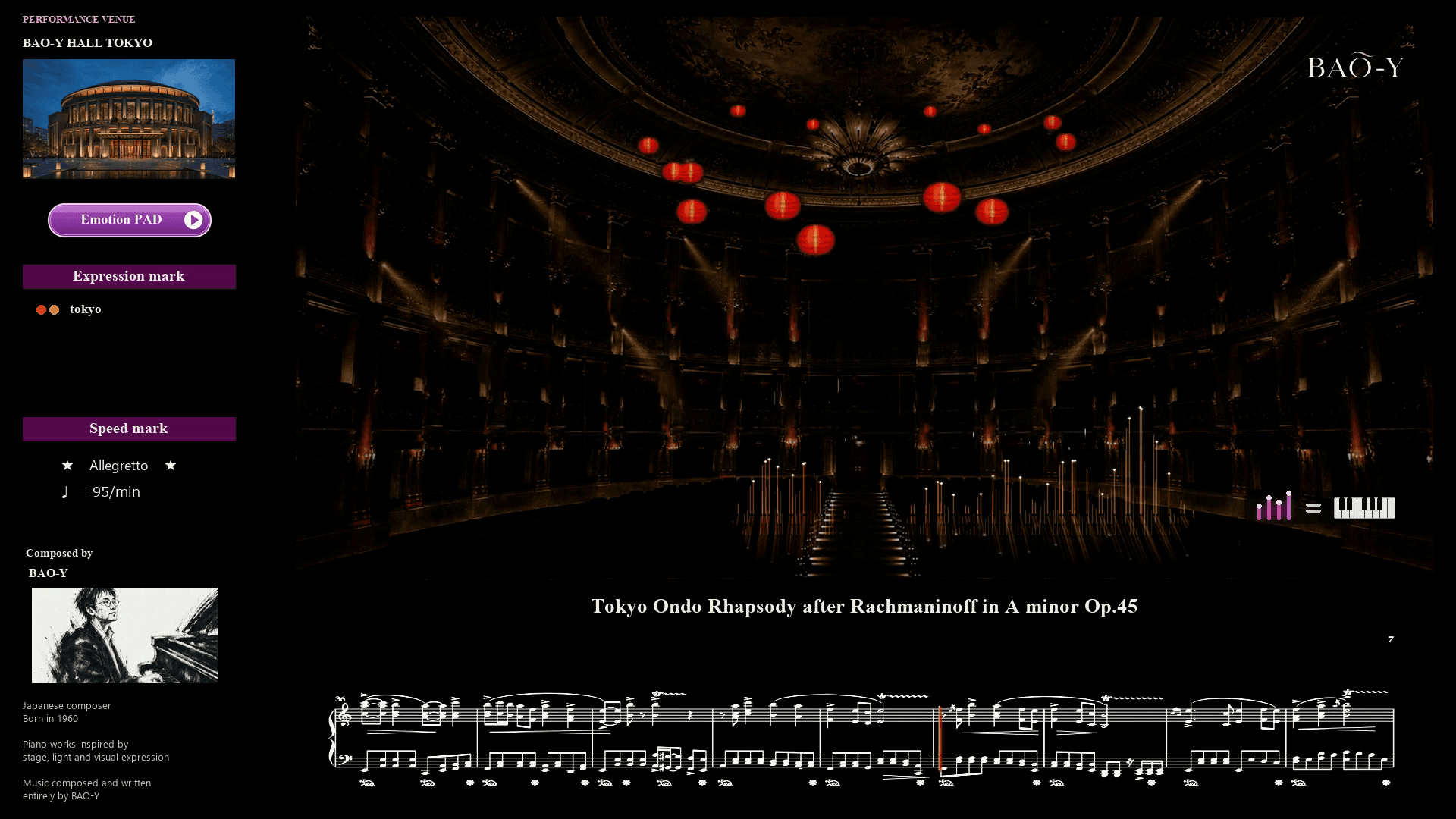
Festival colour extends the rhythm into space
- Lanterns and changing light provide a visual entrance into the festival character of the music.
- The score remains visible so the musical construction and its demanding piano writing stay central.
- BAO-Y HALL TOKYO is a virtual concert hall, not a physical venue; it gives the musical contrast a stage of light and space.
Listen, understand, play
Where this work can lead
The meeting of Japanese festival rhythm, drum-like energy, and the weight of the classical piano.
A technically demanding work, especially in the accelerando toward the ending; the score is available for pianists.