

A historical drama without a fixed period, person, or imposed story.
All works
Original composition
Scherzo No. 2 “TAIGA” in G Minor, Op. 22
A fast-moving piano work conceived in the spirit of a Japanese historical drama.
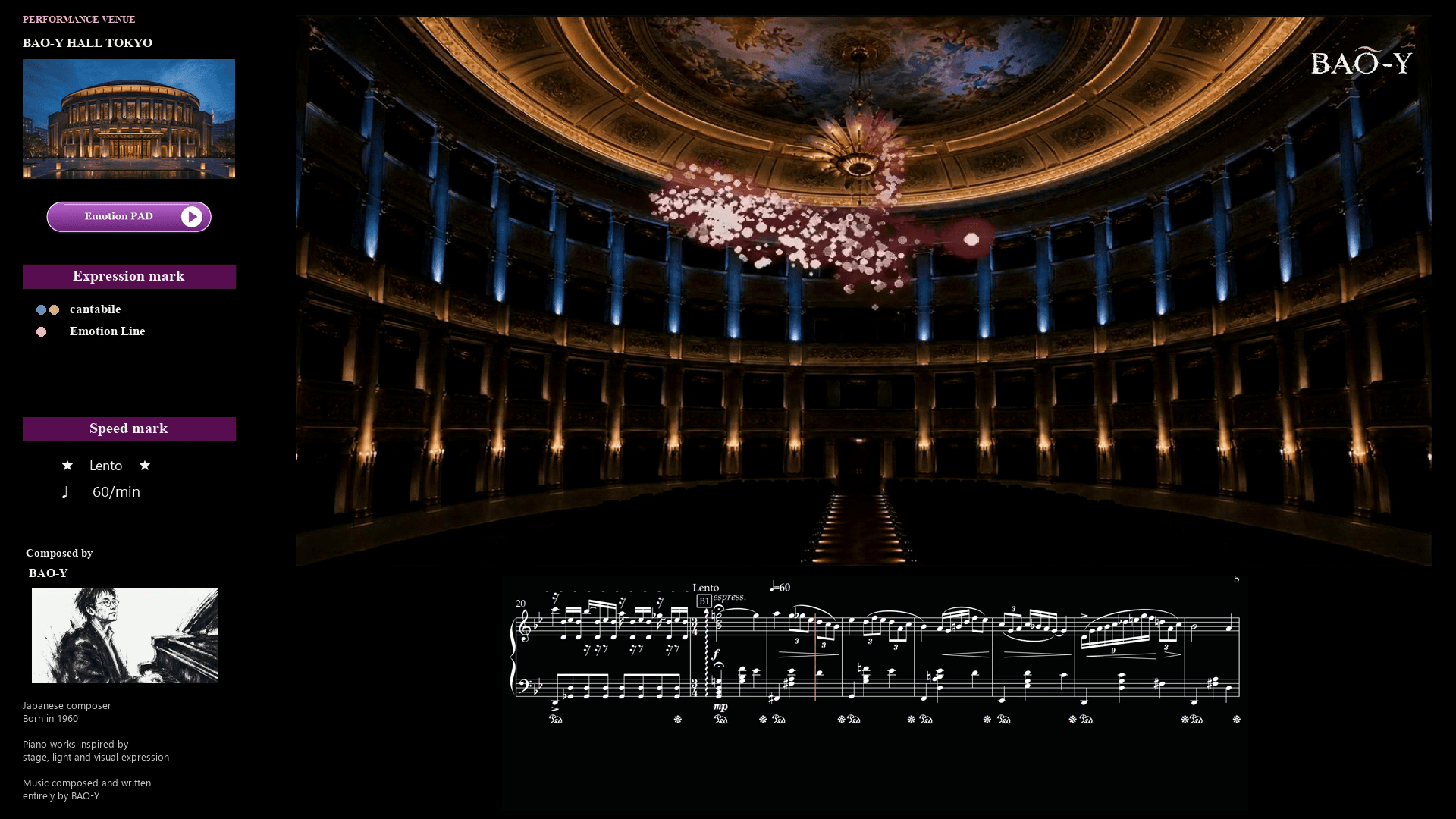
Concert hall: BAO-Y HALL TOKYO ↗
The musical doorway
A life flowing like a great river
The Japanese word taiga means a great river. The composition imagines history from beginning to end as a river and traces the eventful life of a person born into an unstable world, confronted by injustice, supported at times by family, and driven toward deeds that may remain in history.
No particular historical figure or drama is assigned to the work. Instead, the opening, middle, and ending take on different expressions and allow each listener to imagine a different life and age.
The work is written in G minor. It was composed to express not only the hardship of living in an unstable environment, but also the warmth of family and the conflicts that arise within the heart. Its speed and momentum carry these changing emotions forward.
What to notice
The visual world follows the drama already in the music
- Changes in light, colour, and space respond to the contrasting musical sections rather than replacing them.
- The visible score keeps the composition at the centre of the experience.
- BAO-Y HALL TOKYO is a virtual concert hall, not a physical venue; it was created as a stage on which the music can expand into light and space.
Listen, understand, play
Where this work can lead
G minor, with fast movement, dramatic contrast, family warmth, and inner conflict.
The piano score is available for listeners who would also like to explore the work through performance.